Get this template emailed to you
Three fields. Lands in your inbox in a couple of minutes. No drip campaign.
Sent.
If it doesn't show up in 5 minutes, check spam or reply to hello@servantium.com.
A Professional Services Operating System is the system of record and the system of action for services delivery. It holds the shape of every engagement, the people on it, the decisions that have to be made, the risks that are live, the dependencies that are slipping, and the artifacts that prove what was agreed. All in one model the operator can query rather than reconstruct from chat history every Monday.
This is a category argument
Professional services has run for three decades without a real infrastructure layer of its own. Every tool built around it was designed for someone other than the person running the work.
The PSA was shaped for the CFO dashboard. The CRM goes dark the moment the contract is signed. CPQ encodes what you charged last time, cut off from what you actually delivered. AI agents automate tasks but cannot reason across a lifecycle when the data beneath them is weak. None of these tools understand what an engagement is. None of them were built for the Engagement Manager on a Monday morning.
That gap has a name now. The Professional Services OS is the layer that was never built. This report makes the case for it. And it is a case worth making, because the firms that name and build this category first will shape how every services firm operates for the next decade.
What the report covers
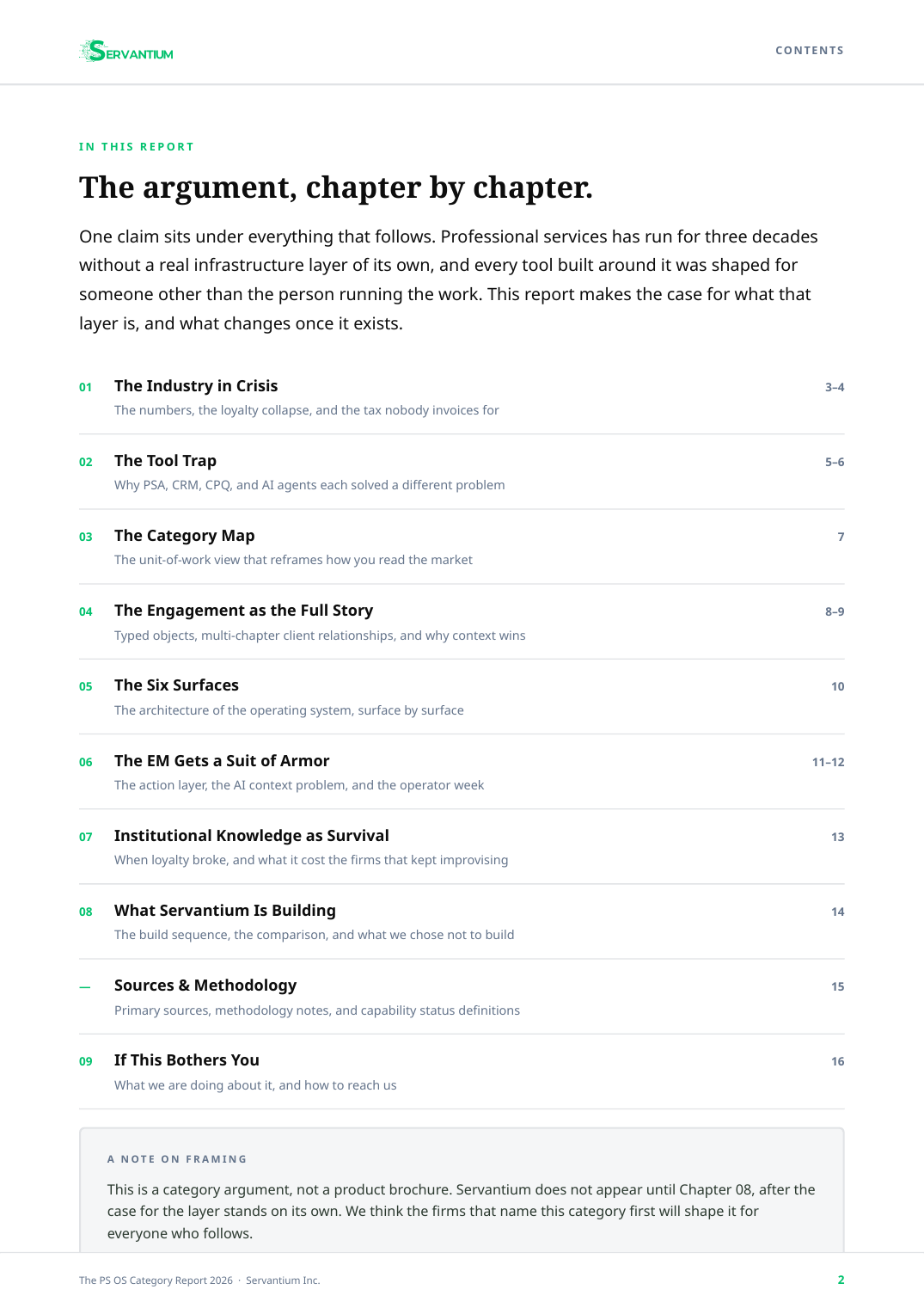
The PDF is sixteen pages. It is a category argument, not a product brochure. Servantium does not appear until page fourteen, after the case for the layer stands on its own. Here is what you will read.
Chapter 01: The Industry in Crisis. The numbers are specific. Billable utilization sits at 68.9 percent, six points under the margin threshold. One in four projects runs late. Only one in five firms consistently hits profit targets. The report opens with these figures, but the more interesting argument is what they point to. The shortfall is not talent. It is infrastructure. Every industry that hit this wall answered it with a new layer: manufacturing got ERP, software got DevOps, healthcare got the EMR. Professional services got spreadsheets and a shared drive, and then stopped.
Chapter 02: The Tool Trap. This chapter lays out why PSA, CRM, CPQ, and AI agents each solved a different problem and left the delivery operator in the gap. The argument is structural, not a vendetta against any category. Each tool has a unit of work it knows how to hold: the timesheet, the opportunity, the quote, the task. None of them hold the engagement. The EM opens five tabs every Monday and stitches together context that should have been preserved automatically. That stitching is the tax nobody invoices for.
Chapter 03: The Category Map. A single diagram makes the gap visible. Map every software category by its unit of work against its delivery depth, and one quadrant is empty. That quadrant is the PS OS. The chapter also introduces a secondary argument: AI is only as good as the data it runs on. Without a structured engagement layer, you hand a capable model the wrong inputs and wonder why the output falls flat.
Chapter 04: The Engagement as the Full Story. This is the core structural chapter. An engagement is not a project. It is the whole arc of a client relationship, holding dozens of opportunities, multiple active projects, and years of history as one coherent, queryable object. The chapter introduces the engagement schema (decisions, risks, dependencies, milestones, people, history) and explains why the difference between a typed object and a slide deck is not cosmetic. A typed engagement survives a rotation. A slide deck does not.
Chapter 05: The Six Surfaces. The PS OS has six surfaces, and they are not six modules sold apart. They are six facets of one engagement model. The engagement layer holds the queryable spine. The single source of truth computes status from the model rather than from a color picked on a Wednesday afternoon. The RAID review process turns each row into a workflow with an owner, a question, and a closed-state. Decision architecture makes every decision a first-class object with a maker and a deadline. The capacity model becomes a what-if engine, not a Gantt chart. The content layer generates status decks, change orders, and handoff packs from the data that already lives there. A PS OS that ships any single surface without the others is still just a tool.
Chapter 06: The EM Gets a Suit of Armor. The Engagement Manager is the protagonist of the next decade of services delivery. The report works through the operator week before and after in concrete terms. Tuesday without the PS OS: five tabs, a stale deck, fourteen unread Slack threads, ninety minutes of context reconstruction before a sponsor meeting. Tuesday with the PS OS: one screen, four open decisions with deadlines, two risks aged past threshold with the question to ask each owner already surfaced, a sponsor meeting that takes twenty-five minutes because everyone decides instead of reconstructing. The second-order effects are what the chapter spends the most time on. The EM stops apologizing. The firm stops losing margin on work it should have won.
Chapter 07: Institutional Knowledge as Survival. The talent crisis of 2021 and 2022 turned an inefficiency into a structural problem. Reported attrition at major consultancies reached 30 to 40 percent a year. The implicit deal behind institutional memory, stay long enough to become the firm’s operating context, came apart overnight. The chapter explains why a structured engagement model changes the math. Knowledge that lives in a queryable model does not walk out the door with the person who built it.
Chapter 08: What Servantium Is Building. Scope, price, propose, deliver, and learn, in one system, where delivery outcomes feed the next estimate rather than dying in a spreadsheet. The chapter includes a capability comparison across the engagement lifecycle and is explicit about what is live today versus what is still on the build sequence. There is no overclaim here.
Why we think this category matters
The category argument is simple. Professional services firms run on the judgment of the people doing delivery. They always will. The question is whether those people are spending their finite hours on judgment, or on reconstruction.
When an EM spends the first ninety minutes of a Friday rebuilding context that already existed somewhere across five disconnected tools, the firm is paying twice: once for the tools, once for the time. When an EM rolls off an account and takes six to eight weeks of context out the door with them, the firm pays a third time on the ramp. This is not a talent problem. It is an infrastructure problem, and it has a structural answer.
The PS OS is that answer. The engagement is the unit of work that has never been a first-class object in any platform. Making it one, building the six surfaces that sit on top of it, and putting a queryable model in the hands of the people who run delivery is what this category is for.
Every industry that solved its knowledge problem with infrastructure came out the other side more resilient, more scalable, and able to do more with the talent it had. Professional services is next. The firms that see this clearly and move early will hold an edge that compounds.
We built this report to name the category clearly enough that the industry can start building around it. Read it. Share it with the delivery leads in your firm who have felt this weight. The category forms faster when more people know what they are building toward.
What's inside
- The industry data: utilization, attrition, margin miss, and why the infrastructure explanation holds up where the people explanation falls short.
- Why every existing tool category (PSA, CRM, CPQ, AI agents) serves a different reader, and the gap that leaves in the middle.
- The engagement as a typed, queryable object: the unit of work that has never been a first-class citizen in any platform.
- The six surfaces of the PS OS architecture and why a system that ships only one of them is still just a tool.
- What changes for the EM: the operator week before and after, and the third-order effects for the firm.
Why we made this
Professional services has run for three decades without a real infrastructure layer of its own. Every tool built around it was shaped for someone other than the person running the work. This is the category argument for the layer that was never built, written for the people who have felt the absence of it every Monday morning.